
7 Tactical Principles for Creating Space in Soccer and Tennis: Spatial Awareness in Sport
The Universal Mechanism Every Athlete Needs to Master
How to use spatial manipulation to draw opponents out of position, generate scoring chances, and win more points in soccer and tennis

Po Polsku 🇵🇱: Trzeba rozumieć jak się gre czyta i jak obrońca czy piłkarza z drugiej drużyny się wyciąga z miejsca aby było lepsze poddanie i możliwości na strzał. Ten sam mechanizm jest widziany w piłce nożnej, futsal, tenis i tak dalej.
Introduction
Whether you're a soccer player reading the half-spaces before a through ball or a tennis player pulling an opponent wide off the baseline, the underlying mechanism is the same. Spatial awareness in sport — the ability to manipulate space, read body movement, and exploit openings before they close — is the single greatest separator between good athletes and elite ones. It doesn't require superior speed or strength. It requires understanding.
Most players on both sides of the ball struggle with the same set of problems:
They don't know where space exists before they receive the ball.
They react to what's happening rather than reading what's about to happen.
They don't understand that drawing an opponent out of position is the prerequisite to scoring — not the shot itself.
They telegraph their intentions through body shape, giving opponents time to recover.
They can't identify the difference between an overloaded and underloaded zone in real time.
This guide is built for the athlete or student who wants to understand the tactical architecture behind space creation — and how the exact same principles govern both soccer and tennis. Once you see the pattern, you can't unsee it.
If your looking for melodic house combined European elements, with reggaeton or dembow beat, because you are looking for something that is a bit orchestral has some Glockenspiel, and want to experience something different then listen to Podium. You have piano, synth, guitar and more.
Listen and Save on Spotify.
🏆 Gold Nugget #1: Space Is Created Before the Ball Moves In both soccer and tennis, the work that creates space happens before the pass or shot. A well-timed run off the ball, a body feint, or a shot to one corner draws the opponent — and the space opens on the other side. The ball exploits space that already exists; it doesn't create it. |
In soccer and tennis you start to see a pattern in space and opportunities. You sometimes wonder why wasn’t the ball passed or hit there. This is where you see the need for spatial awareness training, intuition, and vision.
Spatial Awareness In Sport: The Shared Mechanism: Draw, Displace, Deliver
The core tactical sequence is identical across both sports. First, you draw an opponent out of their optimal position — either through a run, a pass, a shot, or a feint. Second, this displacement creates either an overload (you outnumber defenders in one zone) or an underload (you leave space behind). Third, you play the ball into the vacated space where a free player or a clean shot opportunity exists.
In soccer, spatial awareness in sport operates at a team level. According to Coaches' Voice, the overload-to-isolate principle involves committing extra players to one side of the pitch, drawing more defenders across with them, then switching play quickly to an isolated attacker with space. Teams like Bayern Munich under Guardiola used Ribéry and Robben precisely this way — overload left, switch right, 1v1 in open space.
In tennis, the mechanism is a one-on-one version of the same logic. Pull your opponent wide with a sharp crosscourt shot, hold them there long enough to commit their weight, then strike down the line into the space they've vacated. Tennisprime notes that a wide serve on the deuce court can pull a right-handed opponent off the court, leaving the other side completely open.
🏆 Gold Nugget #2: Short Pass to Beat a Deep Opponent If an opponent is far away or positioned deep, the correct response is not to force a long ball. Multiple short passes — a wall pass, a combination play, or a series of crosscourt exchanges in tennis — outpace an opponent who can't close the distance. The short pass forces them to move; the next pass exploits where they moved from. |
Reading Body Movement: The Information Edge
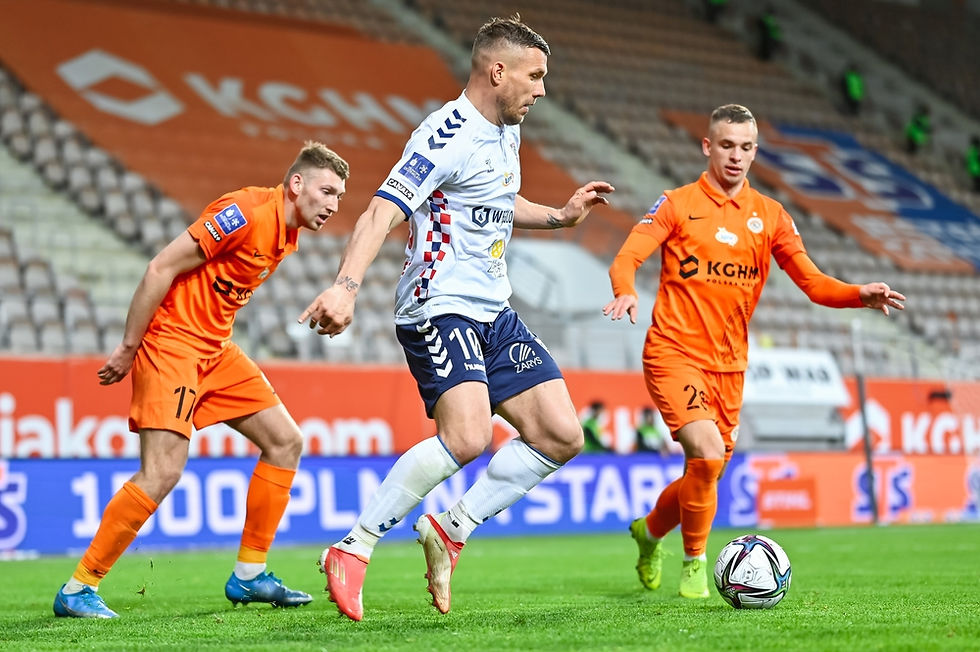
Elite players in both sports read the body before the ball moves. In soccer, a midfielder's hips facing sideways signals a pass direction before their foot touches the ball. In tennis, a shoulder turn and racket preparation telegraph whether a player is hitting crosscourt or down the line.
Beast Mode Soccer describes how experienced midfielders develop a library of spatial patterns — they register cues like a certain defender's movement before consciously processing it, then react accordingly. The same phenomenon applies in tennis: experienced players read the opponent's shoulder angle and racket face orientation before the ball leaves the strings.
This is why spatial awareness in sport is not simply physical — it's neurological. US Youth Soccer's spatial awareness progression document describes "live space" as open space created for a teammate by enticing an opponent away from an area — and this enticing happens through body movement, not just ball movement.
The practical application: scan before you receive. In soccer, check your shoulder before the ball arrives so you know where space exists and can play one- or two-touch. In tennis, watch your opponent's body during your own shot — their recovery position tells you exactly what's open.
🏆 Gold Nugget #3: A Stretched Opponent Can't Defend the Shot When you pull an opponent wide — off the court in tennis or out of defensive position in soccer — they are no longer between you and the target. Their weight is committed in the wrong direction. A stretched opponent takes time to recover, and that recovery window is your shooting window. The stretched defense, not the shot itself, is what creates the goal or winner. |

Overloads, Underloads, and the Free Player
An overload is when you have more players (or more available space) than the opponent can cover in a given zone. An underload is the consequence: the zone they vacated to handle your overload. FIFA Training Centre's elite session on overloads identifies the key principle: attacking players need to make the most of the spare player and focus on the weight and accuracy of the final pass. Finding that spare player is the entire point of the tactical sequence.
In soccer, this plays out as a 2v1 within a larger 4v3 — committing one extra defender through movement, then finding the player they left uncovered. In tennis singles, the "spare player" concept translates to open court: the quadrant your opponent is not covering is your spare player. Hit there.
The critical execution detail in both sports: move the ball fast once the overload is established. Football DNA's tactical analysis notes that teams must shift the ball quickly to prevent defenders from regaining shape. In tennis, this means the second shot — into open space — must follow quickly enough that your opponent can't recover their position.
🏆 Gold Nugget #4: Play Short When the Opponent Is Far — Never Force the Long Ball One of the most common errors in both sports is attempting to hit the 'money shot' from too far away or too early in the sequence. Multiple short passes — or short, controlled angled shots in tennis — force the opponent to keep repositioning. Each time they move, they vacate a new space. The killing blow comes after the displacement work, not instead of it. |

When a Stretched Opponent Means a Clear Shot
The geometry of sport is honest. In tennis, Tactical Tennis's net positioning analysis quantifies this: a player hanging back at the service line leaves 503 square feet of passing court uncovered; a player closing to the net reduces that uncovered space to 293 square feet. The stretched opponent — one who is pulled wide or pushed deep — creates the same effect. They physically cannot cover the open side.
In soccer, a defender who has been dragged wide by an overlapping run or a diagonal ball has left a gap in the central defensive structure. That gap is the shooting lane or the through-ball corridor. The Football Analyst explains that the overload-to-isolate tactic is specifically designed to generate a favorable 1v1 after drawing numbers — which means, by the time you have the shot, the defender is both isolated and stretched.
Both sports reward patience in the buildup and aggression at the moment of release. You don't shoot or strike when the opponent is balanced and centrally positioned. You shoot when they are off-balance, wide, or displaced. That's the window.
🏆 Gold Nugget #5: Body Orientation Is the Cheat Code Before possession or contact, orient your body to see as much of the available space as possible. In soccer, a half-turned body shape facing sideways lets you play forward or back without telegraphing. In tennis, your recovery position after a shot should already account for where your opponent is most likely to respond. Body position is a real-time map of upcoming opportunity. |
Training Programs: Soccer
The following drills are specifically designed to build spatial awareness, overload recognition, and body orientation under pressure.
1. Mannequin Passing Grid (Spatial Awareness)
Set up a 30x30 yard grid with 8–12 mannequins or upright cones arranged in triangles and diamonds. Soccer Awareness's passing game drill instructs players to position themselves in the space between 'opponents' and move continuously off the ball into passing lanes. Limit touches to 2, then 1. This builds the habit of scanning before receiving.
2. 4v3 Overload Progression (Exploit the Spare Player)
Using a half-field or 40x30 yard space, create a 4v3 attacking exercise toward a full goal. The attacking team must complete a minimum of 3 passes and must play through a midfielder before shooting. The constraint forces players to find the spare player before going direct — exactly replicating match conditions for exploiting an overload.
3. Rondo with Switching Zone (Body Shape & Speed of Play)
Set up a traditional 5v2 rondo. Add a rule: whenever the ball is played to a specific corner cone, the entire group must shift and restart the rondo on the opposite side of the grid within three seconds. This trains the habit of reading when to switch play and forces body orientation awareness to accommodate the switch.

Training Programs: Tennis
1. Deep-to-Short Crosscourt Drill (Open Court Creation)
Player A hits deep crosscourt; Player B replies with a short angle. Player A must then make a placement decision — redirect or reset — based solely on whether their feet are balanced. PlayYourCourt's advanced drills guide calls this pattern "point construction" training: it mirrors real rally sequences and teaches discipline around shot selection. Going for a winner off-balance is a tactical error, not just a technical one.
2. Angle and Chase Drill (Overload-to-Isolate in Singles)
From the baseline, hit a sharp angle crosscourt to a target cone near the singles sideline. Your practice partner or ball machine then returns deep and central. You must hit a second ball into the open court created by your first shot. Talking Tennis's pro tactics breakdown identifies this as "opening on the first ball, adding pace on the second" — the key two-shot sequence for displacing and then finishing.
3. Recovery Position Awareness Drill (Reading Body & Space)
After every groundstroke in live rally practice, call out the quadrant you expect your partner to target before they make contact — based purely on their body position, shoulder turn, and racket preparation. USTA head pro Rita Gladstone notes that spatial awareness — knowing where you are, where the ball is, and where your opponent is — is critical to winning points. This drill builds that real-time triangulation.
5 Actionable Steps to Implement This Week
Apply these immediately in practice or match play:
Scan before every touch. In soccer, check your shoulder before receiving. In tennis, observe your opponent's position while you are setting up your own shot. You should never make contact — ball to foot or ball to racket — without knowing where the open space is.
Commit to the short pass first. When your opponent is deep, positioned centrally, or well-organized, resist the instinct to go direct. Play short to pull them out of shape, then exploit the space they leave. This applies to a wall pass in soccer or a sharp slice angle in tennis.
Track opponent body orientation, not just ball location. Where your opponent's hips are facing tells you where they can and cannot go next. Build the habit of reading body shape so you can anticipate recoveries and commit to your decision before they can adjust.
Train overload drills with constraints. In soccer, add a minimum pass rule to overload exercises to force players to find the spare man. In tennis, designate one quadrant as off-limits for three shots to force pattern-based space creation rather than reactive hitting.
Shoot or strike only when the opponent is displaced. Train yourself to recognize the moment a defender or opponent is off-balance, wide, or out of position — and make that the trigger for your attacking action, not the presence of the ball at your feet or in your strike zone.
Conclusion: One Mechanism, Two Sports, Unlimited Application
The architecture of space creation is not sport-specific — it's universal. Draw the opponent out, generate an overload or underload, deliver the ball where they are not. Whether you're reading a defender's hips in the 18-yard box or tracking an opponent's shoulder turn at the baseline, you are operating the same tactical engine. The athletes who internalize this — who stop reacting and start manipulating — are the ones who make the game look easy. It's not instinct. It's trained spatial awareness in sport, and it's available to anyone willing to build it systematically.
References & Further Reading
1. Coaches' Voice — Overloads: Football Tactics Explained: https://learning.coachesvoice.com/cv/overloads-football-tactics-explained-guardiola-liverpool-messi/
2. FIFA Training Centre — Creating and Exploiting Overloads: https://www.fifatrainingcentre.com/en/practice/elite-sessions/in-possession/creating-and-exploiting-overloads.php
3. The Football Analyst — Overload-to-Isolate Tactics: https://the-footballanalyst.com/overload-to-isolate-tactics-creating-superiority-to-unlock-space/
4. Football DNA — Tactical Analysis: Exploiting Overloads: https://footballdna.co.uk/features/tactical-analysis-exploiting-overloads/
5. Beast Mode Soccer — Scanning and Spatial Awareness in Soccer: https://beastmodesoccer.com/the-importance-of-scanning-and-spatial-awareness-in-soccer-from-early-development-to-elite-play/
6. US Youth Soccer — Spatial Awareness Progression (PDF): https://www.usyouthsoccer.org/wp-content/uploads/sites/160/2023/09/Player-Development-Model-Spatial-Awareness.pdf
7. Soccer Awareness — Passing Game for Spatial Awareness Development: https://www.soccerawareness.com/blog/passing-game-for-spatial-awareness-development
8. Tactical Tennis — How to Position Yourself at the Net in Singles: https://www.tacticaltennis.com/how-to-position-yourself-at-the-net-in-singles/
9. Tennisprime — The Role of Court Dimensions in Tennis Strategy: https://tennis-prime.com/blogs/all/the-role-of-court-dimensions-how-players-use-geometry-to-gain-the-advantage
10. Talking Tennis — Four Tactics From the Pros You Can Use Now: https://talkingtennis.net/blog-posts/tennis-problem-solving-four-tactics-from-the-pros-you-can-use-on-court-now
11. USTA — Improve Your Game: Court Positioning: https://www.usta.com/en/home/improve/tips-and-instruction/national/improve-your-tennis-game--court-positioning.html
12. PlayYourCourt — Tennis Drills for Advanced Players: https://www.playyourcourt.com/news/drills-advanced-players/


Comments