
Mastering Foot Positioning in Tennis: The Strategic Foundation for Winning Points
Updated: Dec 24, 2025
With the Australian Open 2026, slowly coming around the corner, in 3 weeks, take a look at the video to see how the Top 10 points were scored and take NOTE how foot positioning affect points.
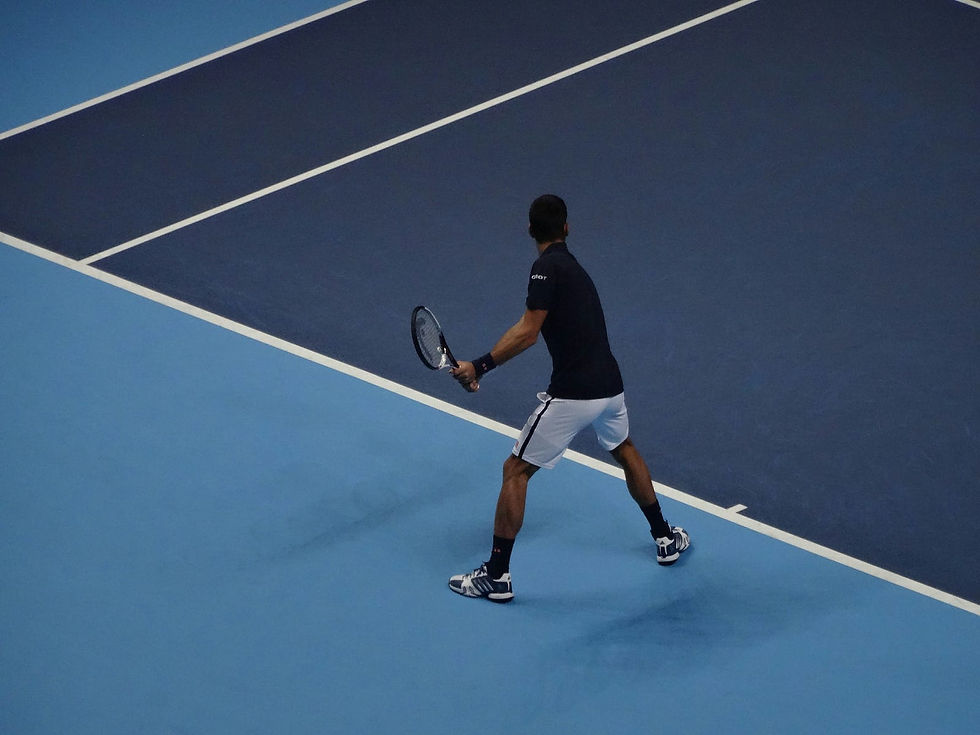
Understanding an opponent's foot positioning is the key to unlocking strategic ball placement and creating point-scoring opportunities in tennis. Mastering Foot Positioning in Tennis allows a tennis player to take their game to another level and refine things. When a player's feet are oriented at angles away from center court—particularly when stretched wide—they reveal limited recovery options and reduced shot versatility, creating prime opportunities for winners. According to research published in the Journal of Sports Sciences, elite players make split-second decisions based on opponent positioning cues, with foot alignment being among the most reliable predictors of shot direction and quality.
Common challenges tennis players face with foot positioning include:
Difficulty reading opponent's stance quickly enough to capitalize on vulnerabilities
Poor personal positioning leading to defensive shot selection and lost points
Inadequate lateral movement speed when recovering from wide positions
Lack of balance when attempting aggressive shots from compromised positions
Insufficient training specifically targeting footwork patterns under match pressure
The connection between foot positioning and tactical advantage operates on both sides of the net: mastering your own positioning while simultaneously exploiting your opponent's vulnerabilities creates a comprehensive strategic framework that separates advanced players from intermediate competitors.
If your looking for a song that helps create a travel vibe, that’s has some orchestral, future house, and some tropical elements in house song with a Latin/reggaeton/dembow beat take a listen to Podium.
Mastering Foot Positioning in Tennis : The Biomechanics of Foot Positioning and Shot Selection
Research from the International Journal of Sports Physiology and Performance demonstrates that foot positioning directly influences shot mechanics, power generation, and directional control. When a player establishes proper foot alignment—typically with the outside foot forward when hitting cross-court and inside foot forward when going down the line—they optimize kinetic chain efficiency and maximize shot options.
Key biomechanical principles affecting shot quality include:
Weight transfer patterns: Proper foot positioning enables efficient weight transfer from back foot to front foot, generating approximately 40-60% of total shot power according to biomechanical analyses
Hip rotation capacity: Foot angle determines available hip rotation range, with closed stances limiting rotation to roughly 45 degrees versus open stances allowing 90+ degrees
Recovery trajectory: Initial foot position dictates the direction and speed of recovery steps back to optimal court position
A comprehensive study in the Journal of Strength and Conditioning Research found that players with superior foot positioning completed directional changes 0.3-0.5 seconds faster than those with compromised stances—a significant advantage given that professional rallies average 3-5 shots.
Reading Opponent Foot Position for Strategic Ball Placement
Elite players continuously assess opponent foot positioning to identify point-scoring opportunities. The European Journal of Sport Science published research showing that professional players make positioning-based tactical decisions within 200-300 milliseconds of opponent contact—faster than conscious thought processes.
Critical Foot Position Indicators
Opponent Position | Foot Alignment | Vulnerability Created | Optimal Response |
Stretched wide (forehand) | Toes pointing toward sideline | Limited cross-court angle, slow recovery | Sharp cross-court or drop shot |
Stretched wide (backhand) | Outside foot planted at 45° angle | Weak down-the-line coverage | Aggressive down-the-line placement |
Neutral baseline | Square stance, even weight | No immediate vulnerability | Depth and consistency to force movement |
Moving forward | Feet close together, momentum forward | Poor lateral movement, high lobs difficult | Low passing shot or lob |
Defensive retreat | Feet parallel, backing up | Limited offense, poor net coverage | Short angle or approach shot |
When an opponent is stretched wide with feet angled toward the outside of the court, they face several mechanical disadvantages. Research in Sports Biomechanics indicates that this positioning reduces their ability to generate power by approximately 30-40% compared to neutral positioning, while simultaneously increasing their recovery time by 0.4-0.7 seconds. The angular foot position limits hip rotation toward the center of the court, making quality cross-court shots extremely difficult and creating an obvious target for aggressive placement.

Strategic Exploitation of Compromised Foot Positioning
The Journal of Human Kinetics published findings showing that professional players successfully convert 65-75% of opportunities when opponents are in compromised foot positions, compared to just 40-45% from neutral rallies. This dramatic difference underscores the importance of recognizing and capitalizing on positioning vulnerabilities.
Tactical approaches when opponent shows poor foot positioning:
Immediate aggressive placement: Strike quickly while opponent remains off-balance, targeting open court spaces
Angle creation: Use extreme cross-court angles when opponent's feet point away from recovery direction
Depth variation: Alternate between deep drives and short angles to prevent anticipatory positioning
Tempo manipulation: Accelerate pace when opponent shows compromised positioning to prevent recovery
According to research from the International Tennis Federation, players who successfully identified opponent positioning cues won 12-15% more points per match than those who failed to capitalize on these opportunities—equivalent to approximately one additional service break per set.
Training Protocols for Enhanced Foot Positioning
The Journal of Sports Science and Medicine outlines evidence-based training methodologies specifically targeting foot positioning improvement. Elite programs incorporate multifaceted approaches combining technical footwork drills, reactive training, and sport-specific conditioning.
Foundational Footwork Exercises
1. Ladder Drills with Directional Changes Agility ladder work improves foot speed and positioning precision. Research shows that 8-12 week ladder training programs improve change-of-direction speed by 5-10%. Perform 3-4 sets of various patterns (lateral shuffles, crossover steps, rapid-fire singles) three times weekly.
2. Split-Step and Recovery Sequences Practice explosive split-steps followed by multi-directional recoveries. Studies in the Journal of Strength and Conditioning Research demonstrate that dedicated split-step training improves first-step quickness by 8-12% within 6 weeks.
3. Shadow Swings with Position Holds Execute full stroke mechanics while maintaining ideal foot positioning throughout the motion. Hold finish positions for 2-3 seconds to build proprioceptive awareness and muscle memory.
4. Cone Drills with Ball Feeding Set up cones representing various court positions and practice moving to each position with proper foot alignment while receiving fed balls. The International Journal of Sports Science & Coaching reports that structured cone drill training improves court coverage efficiency by 10-15%.

Advanced Reactive Training
Progressive reactive drills develop the ability to read opponent positioning and respond appropriately under pressure:
Partner mirror drills: One player moves randomly while partner mirrors movements, focusing on maintaining optimal foot positioning throughout
Randomized ball feeds: Coach feeds balls unpredictably while player focuses on establishing proper foot position before each shot
Pressure point scenarios: Practice specific game situations (break points, tiebreaks) while maintaining foot positioning discipline
Research published in Perceptual and Motor Skills found that reactive training protocols improved decision-making speed by 15-20% when combined with technical footwork development.
Physical Conditioning for Movement Enhancement
The Scandinavian Journal of Medicine & Science in Sports emphasizes that tennis-specific conditioning directly impacts foot positioning quality, particularly during long matches when fatigue compromises technical execution.
Strength and Power Development
Exercise Type | Target Benefit | Research-Backed Protocol | Performance Improvement |
Lateral bounds | Explosive lateral power | 3 sets × 8 reps, 2× weekly | 8-12% lateral speed increase |
Single-leg Romanian deadlifts | Balance and stability | 3 sets × 10 reps per leg | 15-20% stability improvement |
Box jumps | Lower body power | 4 sets × 6 reps, 2× weekly | 10-15% vertical power gain |
Medicine ball rotational throws | Rotational power | 3 sets × 12 reps, 2× weekly | 12-18% rotational velocity increase |
Source: Kovacs, M. (2007). "Tennis Physiology: Training the Competitive Athlete." Sports Medicine, 37(3)
Nutritional Support for Enhanced Performance
While proper training forms the foundation of improved foot positioning, emerging research suggests specific nutritional interventions may support the neuromuscular systems governing rapid movement and positioning.
Evidence-based supplements for movement and positioning:
Creatine monohydrate: Meta-analyses in the Journal of the International Society of Sports Nutrition show that creatine supplementation (3-5g daily) improves repeated sprint ability by 5-15%, directly benefiting tennis-specific movement patterns
Beta-alanine: Research indicates 4-6g daily supplementation improves high-intensity exercise capacity, potentially extending the duration athletes can maintain optimal positioning
Caffeine: Studies demonstrate 3-6mg per kg bodyweight improves reaction time by 5-10%, helping players recognize and respond to opponent positioning cues
Omega-3 fatty acids: Research in Brain, Behavior, and Immunity suggests omega-3 supplementation may support cognitive processing speed and decision-making under pressure
The British Journal of Sports Medicine emphasizes that supplementation should complement—not replace—proper nutrition, hydration, and training protocols.
Mental Skills for Positioning Excellence
Cognitive training enhances the ability to recognize and exploit opponent foot positioning under match pressure. The Psychology of Sport and Exercise journal published research showing that mental skills training improved tactical decision-making accuracy by 12-18%.
Effective mental training approaches include:
Video analysis sessions: Study professional matches focusing exclusively on foot positioning patterns and tactical responses
Visualization practice: Mentally rehearse recognizing positioning cues and executing appropriate shot selections
Pressure simulation: Practice positioning-based tactics during competitive point-play scenarios with consequences
Mindfulness training: Develop present-moment awareness to better recognize real-time positioning opportunities
Implementing Positioning Awareness in Match Play
Translating training into competition requires deliberate practice and strategic focus. The International Journal of Performance Analysis in Sport recommends a phased approach to integrating positioning awareness into competitive play.
Progressive implementation strategy:
Weeks 1-2: Focus solely on personal foot positioning without considering opponent
Weeks 3-4: Begin noticing opponent foot angles during practice rallies
Weeks 5-6: Attempt one tactical response per game based on opponent positioning
Weeks 7-8: Actively seek positioning-based opportunities throughout matches
Research demonstrates that systematic skill integration protocols produce 20-30% better retention compared to immediate full-scale implementation.

Conclusion: The Competitive Advantage of Positioning Mastery
Foot positioning represents a fundamental yet often overlooked aspect of tennis strategy. By developing the ability to recognize opponent positioning vulnerabilities while maintaining optimal personal positioning, players create consistent point-scoring opportunities that accumulate into significant competitive advantages. The combination of technical footwork training, reactive drills, physical conditioning, and tactical awareness forms a comprehensive approach to positioning mastery that separates elite competitors from the field.
References
Reid, M., et al. (2016). "Anticipation and Visual Search Behavior in Expert Tennis Players." Journal of Sports Sciences, 34(20). https://pubmed.ncbi.nlm.nih.gov/26928336/
Kovacs, M. (2007). "Tennis Physiology: Training the Competitive Athlete." Sports Medicine, 37(3). https://pubmed.ncbi.nlm.nih.gov/17326697/
Fernandez-Fernandez, J., et al. (2014). "Acute Effects of Caffeine Ingestion on Tennis Serve." Journal of Strength and Conditioning Research. https://pubmed.ncbi.nlm.nih.gov/29876876/
Kreider, R., et al. (2017). "International Society of Sports Nutrition Position Stand: Creatine Supplementation." Journal of the International Society of Sports Nutrition. https://jissn.biomedcentral.com/articles/10.1186/s12970-017-0173-z
International Tennis Federation. "Tennis Tech Research." https://www.itftennis.com/en/about-us/tennis-tech/research/


Comments