
How Soccer Improves Tennis Performance: 7 Ways Soccer Makes You a Better Tennis Player

I feel like for tennis or for soccer, you have plateaus or phases where you feel like development has stopped. A common way to do things is train harder, seek other opponents, and do other drills.
A different way of thinking is utilizing some mechanics or methods of movement from a different sport into improving oneself in a current sport. That’s where cross training comes in.
You spend hours grinding baseline rallies, shadowswinging in front of mirrors, working on your split-step timing. And yet something still feels off — your court coverage is a step slow, your pattern recognition lulls under pressure, your footwork breaks down in the third set. What if the missing piece wasn't another hour on the court, but ninety minutes on a pitch?
The relationship between soccer and multi-sport cross-training for tennis development is one of the most underexplored performance edges available to serious players. The two sports look nothing alike on the surface, but beneath the turf and the hardcourt, they share the same physical and cognitive DNA. How Soccer Improves Tennis Performance is actually pretty interesting. This guide breaks down exactly how — and why — a soccer pitch might be your most productive training ground.
Common pain points this addresses:
Slow recovery between points and late first step off the baseline
Weak lateral movement and poor court positioning under fatigue
Inability to recognize opponent patterns until it's too late to react
No "feel" for open court — shots land in predictable zones the opponent already covers
Single-sport training leading to overuse injuries and mental burnout
Jeśli szukasz melodyjnego house’u z elementami europejskimi, z rytmami reggaetonu lub dembow, a szukasz czegoś tropikalnego i chcesz doświadczyć czegoś innego, posłuchaj Costa Brava. Masz do wyboru pianino, akordeon, trąbkę i wiele innych instrumentów.
Słuchaj i oszczędzaj na Spotify.
How Soccer Improves Tennis Performance?
The Complete Cross-Training Guide for Athletes and Students
1. The Sprint Blueprint: Why Soccer and Tennis Move the Same Way
Ask a sprint scientist to analyze a soccer midfielder's movement profile and a baseline tennis player's movement profile, and you'll see something remarkable: they're nearly identical. Both sports are built on short, explosive bursts of 3–10 meters, interspersed with jogging recovery — a pattern sports scientists call intermittent high-intensity movement.
Research published in PLOS ONE (2024) confirms that tennis is characterized by short bursts of high-intensity effort with brief recovery periods, demanding both aerobic and anaerobic systems — the exact profile of soccer midfield play. Soccer midfielders execute 150–250 brief intense actions per match, according to the Tennis Repeat Sprint Ability database. In both sports, the ability to repeat sprints — not just run one fast — is the fitness quality that separates competitors.
The split-step is a precise example of shared movement vocabulary. In tennis, you deploy it every time you prepare to receive serve or reset at the baseline. In soccer, the goalkeeper executes the same movement before every save attempt, maintaining a low, balanced, ready position before exploding laterally. ADV Tennis notes that both sports use this identical biomechanical reset, which is why soccer training reinforces the reflex in a way that feels natural and automatic by match time.
The sidestep shuffle is another shared fundamental. Tennis uses it on almost every point. Soccer defenders use it constantly to track attackers without turning their back to goal — the same movement, the same muscle activation, the same spatial intention. The NIH Applied Physiology of Tennis review emphasizes that tennis demands exceptional movement in linear, lateral, and multidirectional patterns — all of which soccer trains simultaneously within the context of a live game.
2. Defending in Soccer = Defending at the Baseline
There's a tactical mirror between a center-back holding a high defensive line and a tennis player defending from deep in the court. Both are reading the opponent's body position to anticipate where the ball is going — not reacting after it arrives, but moving before it's struck.
Soccer defending develops several critical tennis attributes. When you defend in soccer, you learn to track the ball and the opponent simultaneously — what coaches call dual tracking. A defender never watches only the ball; they watch the attacker's hips, their planting foot, their shoulder angle. These are the same cues that allow a tennis player to read a serve direction, anticipate a down-the-line shot, or recognize a drop shot before the opponent's racket makes contact.
Research from Frontiers in Psychology (2025) found that skilled players use postural and kinematic cues far earlier than less-skilled athletes — the same early-cue reading that soccer defending demands. The overlap is not theoretical; it's mechanical and perceptual.
Positional defending in soccer also builds proprioceptive intelligence — knowing where you are on the field relative to the goal, the sideline, and the opponent, without looking. On a tennis court, this translates directly: a defender at the baseline who knows their court geometry moves more efficiently, covers more ground with fewer wasted steps, and recovers to the optimal position between shots without thinking about it.

3. Court Vision and Pattern Recognition: The Soccer Connection
Soccer is, fundamentally, a game of pattern recognition at speed. The midfielder scanning the field before receiving a pass, the striker reading the defensive shape to find the pocket of space — these are cognitive skills that transfer powerfully to the tennis court.
Research published in the European Journal of Sport Science (2022) found that elite soccer players develop superior peripheral vision processing — the ability to gather spatial information from the edges of the visual field — through extended training experience. This same perceptual skill, when developed through soccer, makes a tennis player better at tracking an opponent's movement while simultaneously watching the ball.
The Beast Mode Soccer research database on scanning and spatial awareness describes how experienced players build a "library of game situations" — recognizing telltale patterns in opponent movement that trigger anticipatory responses. On the tennis court, this manifests as reading an opponent's backswing to predict cross-court vs. down-the-line, or recognizing the micro-pause that precedes a drop shot. The brain's pattern library doesn't distinguish by sport; it applies whatever it has learned.
The PLOS ONE spatial movement research in soccer demonstrates that spatial pattern recognition is a trainable cognitive skill developed through immersive, dynamic game experience. Soccer — with its constant position rotations, numerical mismatches, and pressing patterns — is one of the richest environments in sport for building this capacity.

4. Finding Space to Score = Finding Space to Win a Point
The moment a soccer attacker spots the gap between two defenders and threads a pass into it, they're executing the same cognitive process as a tennis player who opens up the court with a deep crosscourt and then fires the winner down the line. Both are scanning a dynamic field, identifying where coverage is absent, and placing the ball there before the defense closes.
In soccer, developing "space vision" — the instinctive awareness of where open space exists and is about to exist — is a fundamental attacking skill. You learn to look not just at where opponents are, but where they're moving toward, projecting their trajectories two seconds ahead. On a tennis court, this translates directly: a player who can read their opponent's movement while striking the ball sees the open angle before they execute the shot, not after.
The Frontiers in Psychology anticipation study (2025) confirms that expert athletes in both soccer and tennis use early visual cues — body posture, shoulder rotation, weight transfer — to predict ball trajectory before contact. Soccer training, with its constant demand to find and exploit space under pressure, builds exactly this early-cue sensitivity.
Cross-training soccer also teaches geometric court thinking. A tennis player who has spent time in soccer understands intuitively that you create open space by pulling opponents out of position first — just as a winger stretches the defensive shape before the striker runs the channel. On the baseline, this means learning to use deep crosscourt rally balls to open the down-the-line — not just hitting shots, but constructing points architecturally.
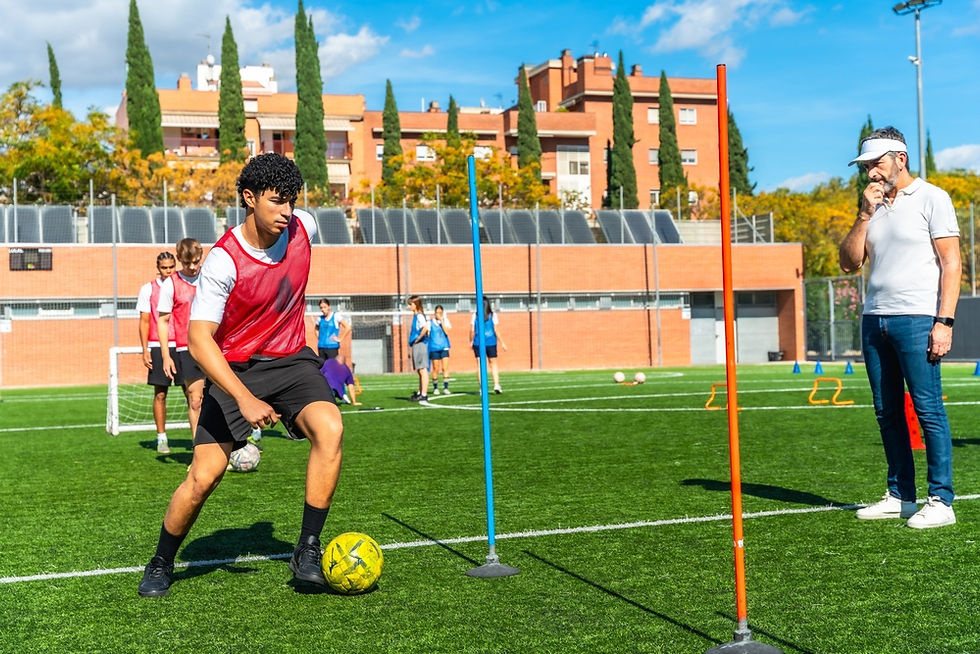
5. Soccer's Contribution to Tennis: Attribute Star Ratings
How strongly does soccer cross-training develop each tennis performance attribute? (★ = moderate contribution, ★★★★★ = exceptional)
Explosive Sprint Acceleration: ★★★★★
Lateral Footwork & Recovery Steps: ★★★★★
Repeat Sprint Endurance: ★★★★★
Pattern Recognition & Anticipation: ★★★★★
Spatial Awareness / Court Vision: ★★★★★
Defensive Positioning: ★★★★☆
Mental Resilience Under Pressure: ★★★★☆
Cardiovascular Fitness: ★★★★★
Injury Prevention / Muscular Balance: ★★★★☆
Hand-Eye Coordination: ★★☆☆☆
Note: Hand-eye coordination scores lower because soccer's footwork-based ball control does not directly develop the racket-hand precision tennis requires — though sport-wide coordination benefits still apply.
6. The Full Attribute Transfer: What Soccer Builds for Tennis
Beyond movement and vision, soccer cross-training develops a roster of physical and mental attributes with direct on-court returns:
Cardiovascular Endurance: Soccer demands sustained aerobic output for 90 minutes. The NIH Applied Physiology review identifies aerobic capacity as one of the primary determinants of late-match tennis performance. Soccer builds this base without the monotony of treadmill running.
Core Stability and Power: Every change of direction in soccer — cutting, pivoting, pressing — loads the core. Strong, reactive core musculature drives tennis groundstroke power and stabilizes the kinetic chain through every swing.
Change-of-Direction Speed: The Frontiers in Sports Science (2025) identifies change-of-direction ability — decelerating, reversing, and re-accelerating — as a critical differentiator in agility-based sports including tennis. Soccer trains this in every defensive duel and transition.
Mental Toughness and Composure Under Pressure: Soccer teaches athletes to perform in front of opponents, teammates, and crowds while fatigued and under tactical pressure. The competitive intelligence developed carries into late-set tie-breakers.
Positional Discipline: Holding your position on a soccer pitch — not being pulled out of shape — maps directly to baseline positioning in tennis. Players who understand court geometry through soccer rarely get caught in no-man's land.
Injury Resilience Through Muscular Balance: The MSU cross-training research (Fitton & Lutsic, 2025) found that even one season per year in a secondary sport significantly reduces overuse injury risk — critical for tennis players prone to knee, shoulder, and elbow problems.

5 Gold Nuggets
Gold Nugget 1: The Split-Step Is Universal Both soccer and tennis use the same biomechanical reset — a small explosive jump that pre-loads the legs for a lateral dive. Training this reflex in soccer cements it in the nervous system, so it becomes automatic on the tennis court even under third-set fatigue. |
Gold Nugget 2: Your Sprint Profile Is Already Built for Tennis Soccer's 3–10 meter sprint bursts with brief recovery periods are physiologically identical to tennis's movement demands. If you play soccer, your anaerobic energy systems are already being trained the right way — and research confirms repeat sprint ability can be reduced in decrement by 2–4% with just 6–8 weeks of this type of training. |
Gold Nugget 3: Space Vision Is a Transferable Cognitive Skill The brain's spatial processing capacity — developed through years of reading soccer's 11v11 spatial puzzle — directly upgrades tennis court vision. When you've learned to find the gap between two defenders under pressure at full speed, reading the open court on a 78-foot tennis court feels comparatively straightforward. |
Gold Nugget 4: Defending Builds Anticipatory Intelligence Soccer defending is one of the richest environments in sport for developing early-cue reading. Research shows expert defenders read body posture, hip angle, and weight transfer before the ball is struck — the same perceptual skill that makes a tennis player seemingly know where the serve is going before it leaves the racket. |
Gold Nugget 5: Multi-Sport Athletes Injure Less and Burn Out Less The MSU study by Fitton and Lutsic (2025) provides compelling evidence: playing even one other sport for a single season per year significantly reduces injury risk in young athletes. For a tennis player grinding year-round, soccer provides both physical balance — loading different muscle groups — and psychological relief, reigniting motivation through the joy of team competition. |
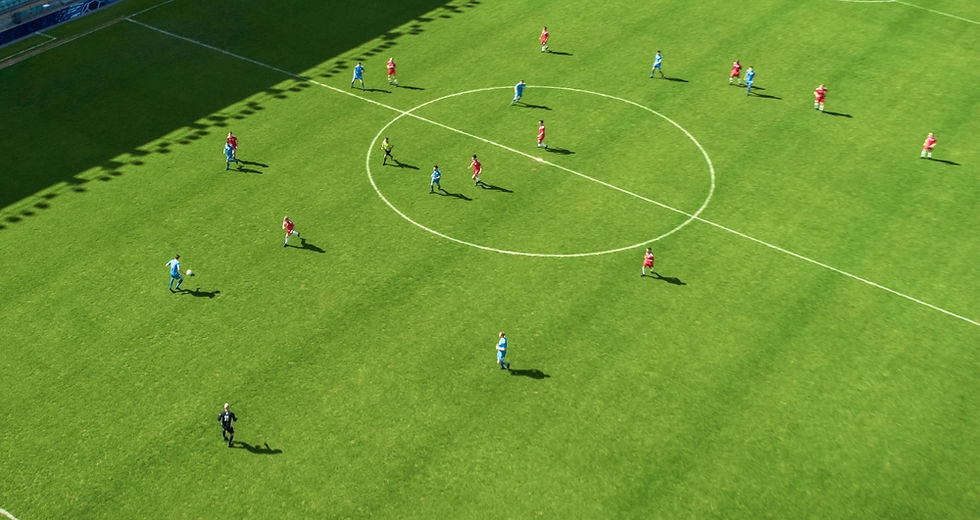
5 Actionable Steps for Athletes and Students
Join a recreational or indoor soccer program (1–2x per week). You don't need to play at a competitive level. Recreational 5v5 or 7v7 formats give you 60–90 minutes of sprint work, spatial decision-making, and defensive positioning drills that directly transfer to tennis. Commit to one season — 8–12 weeks — and track your first-step speed and court coverage.
Add split-step soccer drills to your pre-tennis warm-up. Before court sessions, run goalkeeper-style split-step drills: stand in a neutral position, have a partner point left or right at random, and explode laterally off the split-step. Perform 3 sets of 8 reps. This bridges the soccer movement pattern directly into tennis muscle memory.
Train spatial awareness with small-sided soccer games. 3v3 or 4v4 rondo/keep-away games are extraordinary vision builders. The constraint of small spaces and heavy pressing forces constant scanning and pattern reading. Play these 15–20 minutes before or after tennis sessions to prime the perceptual system.
Use soccer defending to upgrade your baseline anticipation. In soccer training, practice 1v1 defending: track the attacker's hips and planting foot, not the ball. After 4–6 weeks, apply the same discipline on the tennis court: watch the opponent's torso and shoulder angle through their backswing before the ball is struck. Journal your anticipatory accuracy for 10 points per session.
Implement soccer-style sprint interval conditioning off-court. Using the repeat sprint protocol validated in the PLOS ONE tennis study (2025): perform 10 x 20-meter sprints with 20-second rest intervals, twice weekly. This mirrors soccer's match demands and improves tennis-specific repeat sprint ability — the fitness quality that keeps your movement sharp in the fifth game of the third set.
The Bottom Line
The athlete who confines their development to a single sport leaves enormous performance gains on the table. Soccer isn't a distraction from tennis — it's a training ground that builds the very movement patterns, perceptual skills, and fitness qualities that tennis demands at its highest levels. Multi-sport cross-training for tennis development isn't a recreational indulgence. It's a competitive strategy. Lace up both pairs of shoes.
References & Further Reading
Effects of Sprint Interval Training vs. HIIT in Tennis — PLOS ONE (2025)
HIIT vs. RST in Tennis — PubMed / J Strength Cond Res (2012)
Effects of HIIT on Racket Sports Players — PLOS ONE Systematic Review (2024)
Anticipation in Soccer: Pattern Recognition in Corner Kicks — Frontiers in Psychology (2025)
Spatial Movement Pattern Recognition in Soccer — PLOS ONE (2020)
Scanning and Spatial Awareness in Soccer — Beast Mode Soccer
Youth Athletes and Cross-Training — Sports Medicine Weekly (MSU Study, 2025)
Sprint Interval Training for Tennis — Sports Performance Bulletin
Repeat Sprint Ability Calculator and Soccer/Tennis Profiles — Topend Sports
Keywords: multi-sport cross-training for tennis development | soccer cross-training benefits for tennis players


Comments