
Business Opportunities in Tenerife, Spain
- Pavł Polø
- 2 days ago
- 8 min read
A Traveler's Smart-Money Guide to the Island That Plays by Different Rules
SEO Keyword: Tenerife Business Opportunities
Why Tenerife Is Not Just a Holiday — It's a Business Play
You land, the sun hits you at 24°C in February, and you think: why don't more people actually build something here? That question is the right one. Tenerife — the largest of Spain's Canary Islands — is no longer just a sand-and-sangría destination. It's quietly become one of Europe's most compelling locations for Tenerife business opportunities, drawing digital nomads, real estate investors, restaurant entrepreneurs, and sustainability-focused founders who want lower taxes, year-round demand, and a quality of life that mainlanders can only dream about on a Tuesday.
But there are landmines too — bureaucratic friction, a saturated tourist-facing market, and a local housing crisis that's reshaping who can actually operate here. Let's cut through the noise.
The honest pain points before you dive in:
Bureaucracy runs slower than on the mainland — permits and licences take time
The short-term rental market in hotspot areas is increasingly regulated and competitive
Rising property prices are narrowing affordable entry points for first-time investors
Island logistics (importing materials, equipment) add cost layers that mainland operators skip
Finding local skilled labour in specialised sectors is genuinely difficult
Looking for Music for self-development, going through life, traveling, and enjoying life. 🇵🇱 — Muzyka na samorozwój, jak osoba idzie przez życie, podróże, i jak osoba docenia życie.
Listen to Pavł Polø on Spotify.
Tenerife Business Opportunities: The Tax Angle Nobody Talks About Enough
Here's where Tenerife business opportunities separate from anything you'll find in Barcelona or Madrid. The Zona Especial Canaria (ZEC) is a EU-approved special economic zone that slashes corporate tax from Spain's standard 25% down to just 4% — the lowest corporate rate in Europe within a fully regulated jurisdiction.
To qualify, you need to be a newly created entity, maintain a real presence in the Canary Islands, invest a minimum of €100,000 in fixed assets, and create at least five jobs within six months of registration in Tenerife or Gran Canaria. ZEC entities are also exempt from customs duties on imports/exports and can repatriate profits without tax withholding. Full ZEC requirements →
The Canary Islands also use the IGIC (a local equivalent of VAT) at just 7% — significantly below mainland Spain's 21% IVA. Stack that against the ZEC's 4% corporate rate and you're operating in a fundamentally different fiscal universe than the Peninsula.
Real Estate: Still Moving, But Read the Map Carefully
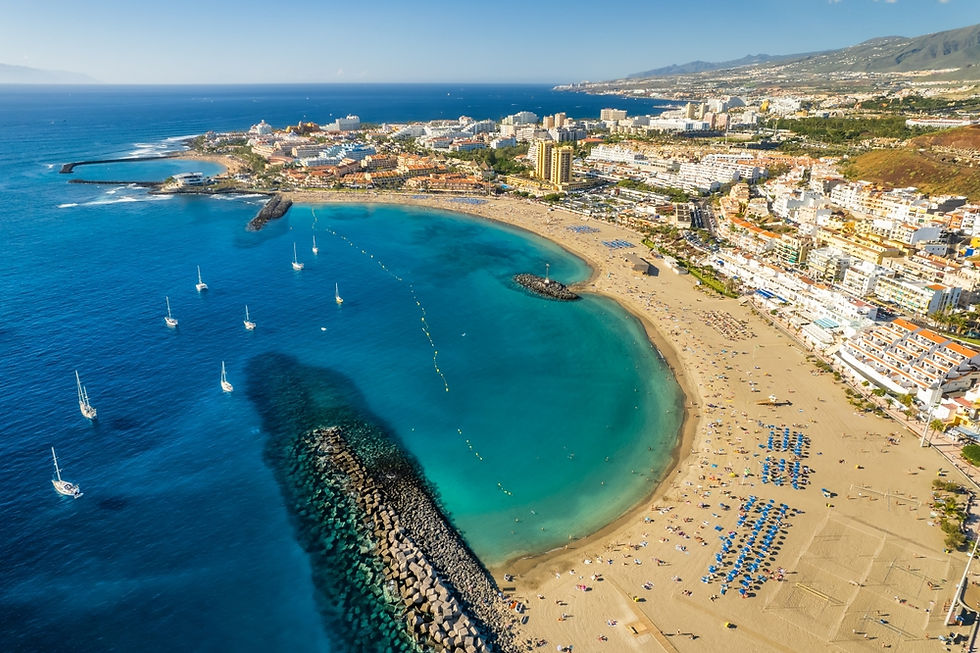
The Tenerife real estate market is active and internationally competitive. In 2025, demand is rising sharply for luxury properties, particularly in Costa Adeje, Playa de las Américas, and Los Cristianos — the island's golden triangle for short-term rental income, buy-to-let, and capital growth. Ocean-view villas and energy-efficient builds are particularly sought after.
For investors with an eye on an emerging entry point, El Médano on the southern coast is generating interest from eco-conscious buyers — apartments starting from around €120,000, with a strong outdoor sports scene (kitesurfing, windsurfing) that draws a younger, higher-spending tourist demographic. Market overview →
Key real estate dynamics:
Buyer profile has shifted: digital nomads, remote entrepreneurs, and institutional family offices are now active alongside traditional retirees
Compared to Marbella or Palma de Mallorca, Tenerife offers stronger rental yields with lower risk of oversupply
Eco-friendly builds with solar, rainwater capture, and sustainable materials command premium pricing in northern areas like Puerto de la Cruz
The island is geographically protected from the construction saturation hitting mainland coastal markets
The Restaurant Sector: Opportunity Buried Under Competition
Over 7 million visitors hit Tenerife in 2024 — the most of any Canary Island. With hotel occupancy consistently above 75% year-round and British tourists alone accounting for 2.8 million arrivals, the F&B sector stays busy. The problem? The Tenerife business opportunities in restaurants aren't in replicating what's already there — they're in the white space.
What's oversaturated:
Mass-market tourist restaurants in the south — paella-and-chips strip dining along resort promenades
Standard café-bar concepts in Santa Cruz city centre
What's underserved:
Farm-to-table concepts tied directly to local organic producers — the island has the agricultural base but not enough operators connecting it to dining
High-end experiential dining in northern Tenerife (La Orotava, Garachico) — areas with heritage architecture and growing tourism but few premium restaurants
Specialist dietary concepts: authentic vegan, raw food, and performance nutrition — demand exists but the quality supply is thin
Sports-adjacent dining near cycling and hiking hubs — catering to the endurance athlete demographic that spends consistently

Marketing: A Sector Running 10 Years Behind the Mainland
Most Tenerife businesses — particularly SMEs, local hotels, and independent restaurants — are operating with marketing strategies that were outdated in 2015. That gap is a real Tenerife business opportunity for anyone who understands SEO, content strategy, paid social, or brand positioning.
The island attracts a multilingual audience (UK, German, Nordic, Spanish mainland) and most local operators aren't reaching any of them effectively in their own language or through modern channels. There is genuine demand for:
Performance marketing agencies specialising in hospitality and tourism verticals
Bilingual (English/German/Spanish) content production for boutique hotels and experience operators
Local SEO and Google Business optimisation for service businesses targeting expat communities
Video production studios serving the growing remote work and digital nomad content creator economy
Organic Farming & Eco-Friendly Materials: The Quiet Frontier
Don't underestimate what grows on this island. Tenerife's volcanic soil and subtropical climate produce year-round yields of tropical and Mediterranean crops — bananas, tomatoes, avocados, papaya, mangoes — all with organic potential. The island's December temperatures range between 15–20°C, meaning farms produce continuously when European counterparts are dormant.
Operations like Finca La Caldera and Finca La Calabacera are demonstrating that farm-to-table subscription models, eco-tourism farm visits, and direct hotel supply contracts work on this island. Permaculture centers near the Anaga Natural Park are already running guided visits, yoga retreats, and organic market supply — and the model is profitable without being saturated. Eco farming in Tenerife →
On the materials side, sustainable construction is the direction the real estate market is heading. Operators sourcing locally produced volcanic stone, recycled building materials, and low-water irrigation systems for agricultural or construction use are entering early in a market that the EU regulatory framework is steadily pushing toward mandatory.

What Makes Tenerife Genuinely Different
Most islands promise sun and relaxation. Tenerife delivers something structurally distinct:
Year-round climate, year-round demand: No off-season collapse. A restaurant, rental, or experience business on Tenerife runs 12 months — that changes the entire unit economics calculation.
Mount Teide: A UNESCO World Heritage Site and Spain's highest peak at 3,718m, visible from the island and accessible for hiking and stargazing. It drives a distinct adventure tourism and astrotourism niche that no other Canary Island replicates at this scale.
Microclimate diversity: The north is lush and green; the south is arid and sun-drenched. This creates distinct product markets — eco and agritourism in the north, beach and resort commerce in the south — on a single island.
African proximity: Tenerife sits closer to Morocco than to Madrid. This positions it as a genuine logistics and innovation hub for businesses targeting West African markets — an angle the ZEC was designed to leverage.
Stable institutional framework: Unlike traditional 'tax havens,' the ZEC operates fully within EU law and European Commission oversight — regulatory security mainland competitors cannot undermine.
Doing Business in Tenerife vs. Mainland Spain: The Key Differences
Tax:
Corporate tax: 4% (ZEC) vs 25% mainland — a fundamental structural advantage
IGIC (local VAT equivalent): 7% vs IVA: 21% on the mainland — direct cost reduction for businesses
Pace & Bureaucracy:
Administrative processes in the Canary Islands are governed by regional institutions — not faster, but often more accessible than national agencies for local entrepreneurs
The island has active business incubators and grants aimed at diversifying beyond tourism — funded at both regional and EU level
Labour Market:
Cost of living is lower than Madrid or Barcelona, but the local skills pool in tech, marketing, and specialised trades is thinner
The expat community provides an international talent layer, but local hiring in niche sectors requires competitive compensation
Consumer Market:
Tenerife's consumer base is a rotating mix of tourists and a 900,000-person resident population — very different from mainland cities driven by domestic demand and seasonal variation
Niches That Aren't Saturated (Yet)
The obvious plays — beach bars, souvenir shops, generic tour operators — are crowded.
These aren't:
Astrotourism: Teide's altitude and clear skies make it one of Europe's top stargazing locations. Professional telescope experiences, astrophotography workshops, and overnight observing camps are barely tapped
Sports performance retreats: Tenerife is already a training base for professional cycling and athletics teams. A structured, well-marketed training camp facility serving amateur athletes (cyclists, triathletes, runners) is an underbuilt opportunity
Tech & remote work infrastructure: Co-working and co-living spaces outside Santa Cruz — particularly in mid-north towns like La Laguna and Los Realejos — where digital nomads want to live but quality infrastructure doesn't exist
Premium organic agri-export: Tenerife-grown tropical fruit with certified organic and Canarian provenance commands European premium pricing — but very few operators have built the export supply chain
Sustainable construction consulting: As EU building regulations tighten, advising local developers on energy efficiency, passive cooling, and volcanic-material integration is becoming a real practice area
5 Gold Nuggets
💡 GOLD NUGGET #1: The ZEC Is Your First Stop, Not an Afterthought
Before you launch anything, run the ZEC numbers. A 4% corporate tax rate versus 25% mainland is not a marginal advantage — it's a structural cost advantage that compounds over years. Get legal advice from a ZEC-specialist Canarian law firm in your first week, not your third year.
💡 GOLD NUGGET #2: Year-Round Demand Changes Your Business Model Entirely
On the mainland, most tourism-adjacent businesses model for high season and survive the rest. In Tenerife, with 7+ million annual visitors and hotel occupancy above 75% most of the year, your business model can assume consistent throughput. That changes staffing strategy, lease negotiations, and growth planning fundamentally.
💡 GOLD NUGGET #3: The North-South Split Is Your Market Segmentation Map
Don't treat the island as one market. The south (Costa Adeje, Los Cristianos) is volume, sun-and-beach, British tourists, mass hospitality. The north (La Orotava, Garachico, Puerto de la Cruz) is slower, more cultural, more European, more willing to pay for quality experiences and organic produce. Match your concept to your geography.
💡 GOLD NUGGET #4: The Underbuilt Opportunity Is in Connecting the Dots
Tenerife has organic farms that don't reach premium restaurants. It has world-class cycling terrain that doesn't have performance retreat facilities. It has one of Europe's best stargazing locations without serious astrotourism operators. The island's opportunity is less about creating new categories and more about building the supply chains and service layers that connect existing assets to waiting demand.
💡 GOLD NUGGET #5: Legal Setup First, Pivot Fast — Island Pace Rewards Adaptability
Regulatory timelines in Tenerife run slower than a mainland capital. Set up your entity correctly from the start (ZEC eligibility, IGIC registration, activity licence), then commit to moving quickly within that structure. Operators who get their paperwork right early can pivot, test, and scale at a pace that slower-starting competitors can't match.
References & Further Reading
All sources verified as of 2024–2025.
© 2025 — Tenerife Business Opportunities Guide | Fact-checked May 2025


Comments