
THE UNIVERSAL EV MOBILITY HUB: Universal EV Charging Station
How the Next-Generation Charging Destination Replaces Chevron, Upgrades Tesla, and Goes Net Zero
SEO Keyword: Universal EV Charging Station | April 2026 | Business Strategy Guide

Quick Summary — What This Opportunity Is in 60 Seconds
The universal EV charging station concept reimagines the roadside stop as a destination: DC fast chargers and wireless inductive pads anchor the experience, while solar canopies, a bistro-café, organic snack retail, a WiFi work lounge, and a battery energy storage system layer on revenue streams and sustainability credentials. Think of it as Chevron and Shell—updated for the electric decade—with the hospitality DNA of a boutique airport lounge. Done right, it beats a legacy Tesla Supercharger on amenities, beats a gas station on margin per square foot, and can reach net zero carbon operation within five years of opening.
This report covers market data, investment ranges, regulatory landscape, complexity, estimated net profit, star ratings, and five actionable steps you can take this week.
If your looking for melodic house combined European elements, with reggaeton or dembow beat, (Moombahton), because you are looking for something that is a bit orchestral has some Glockenspiel, and want to experience something different then listen to Podium. You have piano, synth, guitar and more.
Listen and Save on Spotify.
Pain Points Driving This Opportunity
Before the dollars, acknowledge what the market is crying out for:
Range anxiety is real. A 2025 McKinsey survey found 38 % of non-EV owners say they would switch if charging improved.
Existing fast chargers feel bleak. Most Tesla Supercharger sites today are glorified parking lots — no shelter, no food, no work space.
Traditional fuel stations are dying slowly. With EV penetration projected to hit 50 % of new-car sales by 2030 in the US alone, the gas station model is a depreciating asset.
Dwell-time revenue is left on the table. A 20-to-30-minute fast-charge session is a captive audience; the sector is only beginning to monetize it.
Grid costs are brutal without renewables. Demand charges can consume 40-70 % of an EV charging station's operating costs without solar or storage mitigation.
Consumer wellness trends are accelerating. Organic food, remote work flexibility, and quality-of-life expectations are mainstream — not niche.
The Market Is Already Building This Case for You
The numbers are hard to ignore. The DC fast charging market was valued at USD 10.2 billion in 2024 and is projected to reach USD 30.14 billion by 2030, growing at a 24.2 % CAGR. Zoom out further and the global EV charging station market — spanning all charger types — is on a trajectory toward USD 139.93 billion by 2034.
US federal policy is co-investing alongside you: the Infrastructure Investment and Jobs Act allocated $7.5 billion specifically for nationwide charging infrastructure, channeled through the NEVI program targeting 500,000 public charging stations by 2030. In 2024, US EV sales crossed nearly 10 % of new-car sales. Industry consensus places that figure at 50 % or more by decade's end.
Meanwhile, early evidence from Electrify America, Audi's charging hubs in Germany, and Porsche's Leonberg lounge confirms what customers already feel: charging hubs that offer food, shelter, and connectivity outperform bare-bones stations in dwell satisfaction and repeat visits. Shell Recharge stations in the UK that integrated convenience retail saw site revenue jump 39 % and user dwell time extend by 22 minutes.
This is not a futurist thought experiment. The category is forming right now, and the window to claim premium positioning is open.

The Universal EV Charging Station + Mobility Hub: Every Layer Explained
1. DC Fast Charging (150 kW – 350 kW+)
The foundation. DC Level 3 fast charging delivers 80 % charge in under 30 minutes and commands a premium price per kWh over slower alternatives. Hardware costs range from $30,000 to $150,000+ per unit; a flagship multi-stall site typically deploys 8 to 16 ports. Target NACS (previously Tesla's connector) plus CCS to cover every major OEM on the road today — both standards are now converging across the industry.
2. Wireless Inductive Magnetic Charging
The elegance layer. Inductive charging uses electromagnetic fields to transfer power — no cable, no plug, no connector damage. Current commercial systems (WAVE, InductEV) deliver 125 kW to 500 kW+ at over 92 % efficiency. The wireless EV charging market was valued at $1.17 billion in 2024 and is forecast to surpass $4.12 billion by 2034. Positioning wireless pads in your premium bays adds a meaningful product tier — charge without leaving your seat, or set it going and walk straight to the bistro. This is the feature that converts your site from a necessity stop to a conversation piece.
3. Solar Canopy Station
The economics engine and the brand statement. Commercial solar canopy systems cost approximately $3.17 to $3.99 per watt installed in 2025. A 300 kW canopy array at a typical mid-size site costs roughly $950,000 to $1.2 million before the 30 % federal Investment Tax Credit (ITC), which reduces that figure materially through 2032. Pair with a battery energy storage system (BESS) — commercial C&I storage currently runs $250 to $450 per kWh installed — and the site can store midday solar surplus for evening peak charging, dramatically cutting demand charges. UK operator InstaVolt's Winchester Superhub opened in March 2025 running 870 solar panels alongside battery storage, cutting over 94 tons of CO₂ annually and demonstrating net-zero viability at commercial scale.
4. Lounge, WiFi Work Center, and Bistro-Café
The dwell monetization layer. While drivers charge, they need somewhere to be. An Electrify America customer research study confirmed drivers explicitly want human-scale waiting areas. A well-executed lounge with premium WiFi, standing desks or soft seating, private booths, and power outlets commands a membership or day-pass fee and sells premium beverages. The bistro element — locally sourced coffee, grab-and-go organic meals, fresh juices — targets the 25-to-55 demographic that overwhelmingly represents today's EV buyer: educated, health-conscious, and time-pressed.
The commercial logic is clean: a fast-charge session runs 20-30 minutes. That is an Amazon Prime-level captive opportunity. Studies of retail co-location show charging profitability can more than double when retail sales from extended dwell time are factored in. Your bistro is not a nice-to-have. It is a revenue multiplier.
5. Organic Snack and Healthy Food Retail
Think curated shelves rather than Doritos and energy drinks. Organic protein bars, cold-pressed beverages, local produce, and premium supplements appeal to the same consumer who drives an EV. Margins on specialty food retail (typically 40-60 %) substantially exceed those of the charging service itself, which runs 15-30 % net at well-utilized sites. The food retail component is one of the highest-margin businesses you can attach to a captive audience.
Why This Beats Chevron, Shell, and Tesla Superchargers
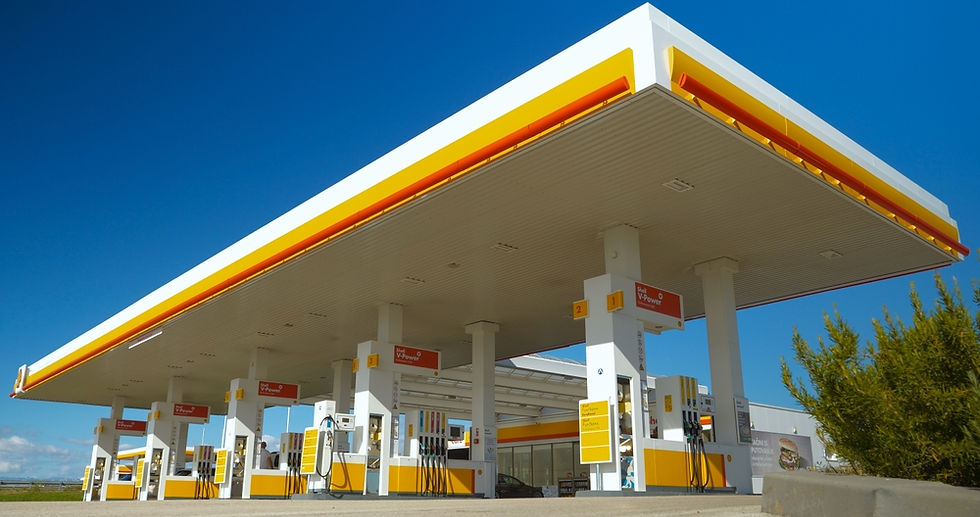
Legacy fuel stations (Chevron, Shell): These operators are not your competition — they are your proof of concept. Shell UK's Recharge network already demonstrated a 39 % revenue uplift when convenience retail was added to charging infrastructure. But legacy brands are encumbered by petroleum real estate, franchise constraints, and a customer experience designed for a 3-minute fuel stop rather than a 25-minute recharge. The universal EV mobility hub is purpose-built from the ground up for the electric era, unshackled by those legacy costs.
Tesla Superchargers: Tesla's network is brilliant infrastructure — reliable, fast, geographically dense — but it remains fundamentally a utility play. Most Supercharger locations offer little beyond the stalls and a weather-exposed canopy. Tesla's own data shows the network opening to non-Tesla vehicles is accelerating, which drives utilization but also crowd-sources the experience problem to whoever owns the surrounding real estate. A well-designed universal EV charging station with a café, lounge, and solar identity creates emotional brand loyalty that Supercharger infrastructure alone cannot.
The Net Zero Pathway: How Realistic Is It?
Achieving net zero carbon operation for a charging hub is genuinely attainable — not a marketing aspiration. The roadmap has three pillars:
Solar + BESS offset: A 300 kW solar canopy in a sun-favorable market (Southwest US, Southeast, California) generates approximately 450,000 to 600,000 kWh annually. That is significant against even a high-utilization 8-stall DC fast charging site's annual consumption. Pair with 500-1,000 kWh of on-site battery storage to smooth the curve and slash demand charges.
Vehicle-to-Grid (V2G) integration: Emerging V2G capability allows parked EVs to feed energy back to the grid during peak-price windows, generating revenue and additional offsets. A Munich VPP project aggregating 3,000 chargers earned €870,000 in grid frequency regulation in Q1 2024 alone.
Carbon credits: BP Pulse in the UK earns £1.8 million annually from its carbon credit portfolio tied to EV charging infrastructure. A thoughtfully certified US site can access Renewable Energy Certificates (RECs) and, in some states, Low Carbon Fuel Standard (LCFS) credits worth meaningful recurring income.
The journal Energy Science & Engineering (Wiley, 2025) confirms that solar PV-integrated EV charging infrastructure, when sized correctly, can reach near-zero lifecycle emissions — and that excess solar can be stored in on-site batteries for after-hours charging without grid dependence.
Investment Required and Financial Projections
Total Capital Investment (Estimated Range)
DC fast charging hardware (8-12 stalls, 150-350 kW): $400,000 – $1,200,000
Wireless inductive charging pads (4-6 premium bays): $300,000 – $600,000
Solar canopy (300 kW, ~1,500 sq ft cover): $950,000 – $1,200,000 (pre-ITC)
Battery energy storage (500-1,000 kWh BESS): $125,000 – $450,000
Site prep, grid interconnection, permits, civil work: $250,000 – $600,000
Lounge buildout, WiFi infrastructure, design: $150,000 – $400,000
Bistro-café kitchen fit-out, equipment: $80,000 – $200,000
Organic retail shelving, initial inventory: $30,000 – $80,000
Total estimated range: $2.3 million – $4.7 million before federal ITC (30 % solar credit) and NEVI/state grants, which can reduce net CapEx by 25-40 % in favorable jurisdictions.
Estimated Monthly Revenue (Mature Site, Year 2+)
EV charging fees (DC + wireless): $25,000 – $60,000/month
Bistro-café food and beverage: $12,000 – $35,000/month
Organic retail: $5,000 – $15,000/month
Lounge memberships, WiFi day passes: $2,000 – $8,000/month
Carbon credits / LCFS / RECs: $1,000 – $5,000/month
Digital advertising (screens, app): $1,000 – $4,000/month
Estimated monthly net profit: $8,000 – $28,000 at a 15-28 % blended margin across revenue streams, assuming a 25-35 % utilization rate on DC chargers and solid foot traffic. Break-even target: 3-6 years, accelerated by incentives.
Complexity Rating, Star Ratings & Ease of Execution
Complexity Rating: 8 / 10
This is a multi-disciplinary infrastructure project involving electrical engineering, food service licensing, renewable energy systems, commercial real estate development, software (network management), and ongoing operations. It is not a project for an inexperienced solo entrepreneur without a skilled team. That said, complexity is manageable through phased buildout and specialist partnerships.
Ease of Execution: ★★☆☆☆ (2/5)
Not easy — but very buildable with the right team, capital, and phased plan. The regulatory environment is the biggest friction point (permitting for DC fast chargers in some jurisdictions takes 6-12 months). Partnering with an experienced EV infrastructure firm for the electrical and permitting side dramatically de-risks execution.
Star Ratings
Customer Satisfaction Potential: ★★★★★ 5/5
Quality of Life Impact (Drivers & Community): ★★★★★ 5/5
Wellness & Wellbeing Contribution: ★★★★☆ 4/5
Environmental / Sustainability Impact: ★★★★★ 5/5
Revenue Diversification & Business Resilience: ★★★★★ 5/5
Ease of Execution: ★★☆☆☆ 2/5
Regulatory Complexity: ★★☆☆☆ 2/5
Regulations, Permits, and Compliance
This is the area that catches most newcomers off guard. Regulatory structure for a universal EV charging station is layered — federal, state, and municipal — and the timelines are real.
Federal level: NEVI program compliance requires minimum 150 kW DCFC, NACS/CCS open-access connectors, 24/7 availability, real-time data reporting, and cybersecurity plans. FERC has not nationalized retail EV charging regulation, leaving states as primary authorities.
State level: States regulate retail electricity sales differently. Some classify CPOs (Charge Point Operators) as utilities, triggering additional oversight. California, New York, Colorado, and others have streamlined DCFC permitting, with AHJ approval timelines of 4-8 weeks in ideal cases, up to 6-12 months for complex grid interconnection.
Municipal / local: Zoning permits for food service (bistro), building permits for the lounge structure, ADA compliance for parking and access, fire code for battery storage, and utility interconnection agreements for solar all run on separate tracks. Budget 6-18 months for a full-site permit cycle in most markets.
Food service: State and county health department licensing for the bistro-café component. Standard process but adds another compliance track.
Environmental: Solar installations require utility interconnection review and, in some jurisdictions, environmental impact assessment for large-scale ground or canopy mounts.
Start the permitting process before you spend a dollar on equipment. Engage a local land-use attorney and a charging infrastructure development firm on day one.

Management Structure and Timeline
Timeline
Months 1-3: Site selection, feasibility study, legal entity formation, permit applications filed.
Months 4-9: Grid interconnection negotiation, equipment procurement, civil/electrical contractor engaged, food service licensing.
Months 10-14: Construction: canopy erection, trenching, charger installation, lounge buildout, solar commissioning.
Months 15-18: Soft open (charging operational), bistro and retail launch, WiFi and app go live.
Year 2+: Full operations, optimization, possible wireless charging retrofit or expansion.
Core Team Requirements
General Manager / Operator: Runs day-to-day. Hybrid of hospitality and operations background.
EV Infrastructure Partner: Licensed electrical contractor with DCFC experience (ChargePoint, EVgo, or independent).
Solar EV Contractor: Certified solar installer familiar with commercial canopy and BESS integration.
Food and Beverage Director: Experienced café operator or franchise partner.
Network Software Provider: IoT-based charging management platform for pricing, monitoring, and user app.
5 Actionable Steps You Can Take This Week
You do not need a $3 million budget to begin. You need momentum. Here is where to start:
Step 1 — Define your market and site criteria. Pull US Census Bureau and DOE AFDC data on EV registration density by zip code in your target region. Look for intersections of high EV ownership, highway-adjacent commercial land, and underserved fast-charging corridors. This takes an afternoon and costs nothing.
Step 2 — Read the NEVI State Plan for your state. Every state submitted a NEVI deployment plan to the DOT's Joint Office. These documents show exactly where federal funding is flowing and which corridors are prioritized. Your best site is probably already on that map. Find your state's plan at the Alternative Fuels Data Center.
Step 3 — Run the numbers with NREL's REopt model. The National Renewable Energy Laboratory offers a free online tool (reopt.nrel.gov) that models optimal solar + BESS configurations for a given site, factoring in local electricity rates and incentives. Input your prospective location and get a preliminary energy economics picture.
Step 4 — Contact your local utility's commercial development team. Grid interconnection lead time is your longest variable. A single call to your utility's commercial team to understand substation proximity, available capacity, and make-ready timelines can save you from a 12-month surprise. Do this before you sign a lease.
Step 5 — Speak to a DCFC infrastructure developer. Companies like ChargePoint, EVgo, Electrify America, and regional CPOs regularly partner with landowners and developers under revenue-sharing models. A partnership can dramatically reduce your upfront capital requirement. Request a partner conversation with at least two operators before deciding whether to own or co-develop your infrastructure.

The Bottom Line
The universal EV charging station — built as a mobility hub rather than a utility stop — is one of the most compelling infrastructure business opportunities of the 2020s. The market is real, the capital is available (including federal subsidy), the consumer is ready, and the competitive landscape is still thin enough that first-movers in underserved corridors will hold lasting advantage.
The gas station was a 20th-century institution. What you are looking at is its 21st-century replacement — cleaner, smarter, more profitable per square foot, and genuinely better for the people who use it. That is not a bad thing to build.
References and Clickable Links
1. DC Fast Charging Stations Market Size & Forecast 2025-2030 — Intellect Markets
2. US DC EV Charger Market 2025 Trends — Joint Charging
3. DC Fast Charging Business Guide — EVBox
4. North America DC Charger Market — Fortune Business Insights
5. EV Charging Station Profit Margin 2025 — Solidstudio
6. Profitable EV Charging Business Models — EVAI Sun
7. Wireless EV Charging Guide 2025 — Pulse Energy
8. Deep Dive: Wireless EV Charging — Electreon
9. EV Charging Stations Adding Lounges & Coffee — Edmunds
10. Solar Parking Canopy Guide 2025 — Solar Tech Online
11. EV Charging Permitting — Alternative Fuels Data Center (US DOE)
12. Federal Policies for EV Charging Infrastructure — Congress.gov / CRS
13. Integration of Solar PV in EV Charging Infrastructure — Tripathi et al., Energy Science & Engineering, Wiley (2025)
14. Evaluation of Solar PV Carport Canopy with EV Charging Potential — Scientific Reports / Nature (2023)
15. Evaluating Utility Cost Savings for EV Charging — NREL (National Renewable Energy Laboratory)
16. Public EV Charging Business Models for Retail Site Hosts — Atlas Public Policy / NYSERDA
17. Top 8 EV Charging Considerations for Retail & Hospitality — GPD Group
18. 8 Most Important EV Charging Trends 2025 — Eleport / Driivz
19. True EV Charging Station Cost 2025 — Link Power Charging


Comments