
THE BUSINESS OF BOUNCE: Why Tennis Balls Die So Fast — And the Fortune Hiding in Long Lasting Tennis Balls
- Pavł Polø
- Jul 16
- 7 min read
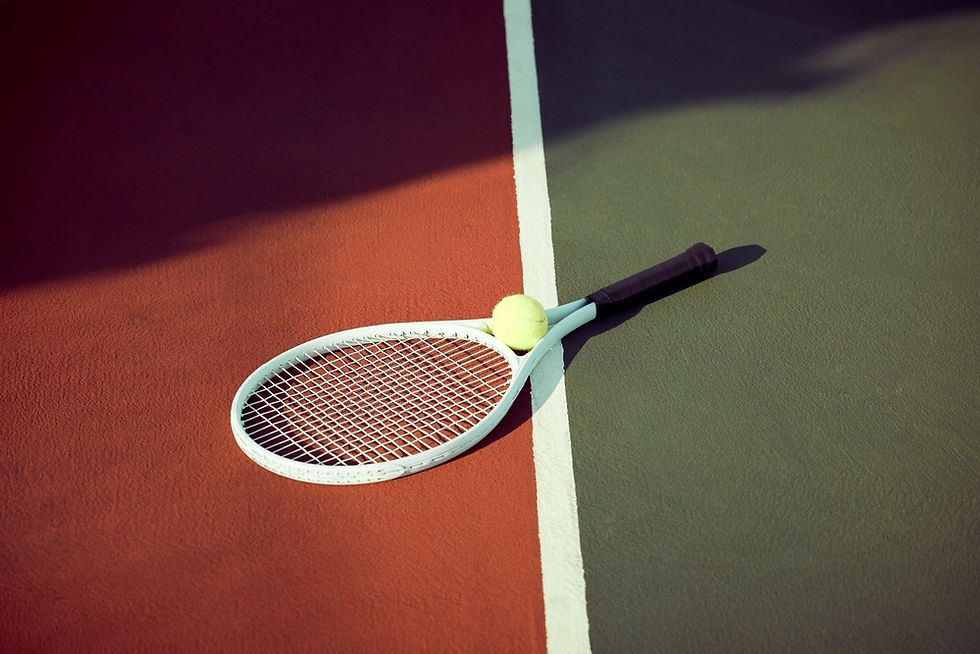
Pick up any can of tennis balls and you already know how this story ends. That crisp psst when you crack the seal is the sound of a countdown starting. Within a few sessions — sometimes a single hard afternoon on a hard court — a lively new ball goes soft, dull, and forgettable. For the everyday consumer, the club pro, the school athletic director, and the sharp-eyed entrepreneur, this isn't a minor annoyance. It's a recurring cost line and, if you look closely, a genuine market opportunity. This guide breaks down why long-lasting tennis balls are so hard to engineer, where all those dead balls actually go, and whether space-age materials like carbon fiber and graphite can finally solve a problem the tennis industry has lived with for a century.
Before we get into the science and the spreadsheet math, here's what's frustrating buyers and businesses alike:
Fresh cans of premium balls lose meaningful bounce within days of opening, even if they're never played with.
Recreational players and clubs are stuck on a buy-play-discard cycle that eats into budgets every single week.
Roughly 125 million tennis balls are landfilled in the U.S. each year, and they take centuries to break down.
Institutions that want to source bulk balls affordably — shelters, retirement homes, schools — don't know where to look.
Few consumers understand that a genuinely more durable ball is a real, fundable materials-science project, not a gimmick.
If your looking for an escape and are looking for melodic EDM music with that European/Mediterranean/Balkan sound and you need a track for summer, traveling, self development, and overcoming personal adversity then listen to Bay of Kotor. It has accordion, chords, orchestral chords, guitar and more.
When creating music, its about crafting a quality song that does not follow a trend but something that represents change through timelessness.
Listen/Follow Pavł Polø on Spotify.
Long Lasting Tennis Balls: Why the Bounce Doesn't Last: The Physics Behind the Problem
A regulation tennis ball is a pressurized rubber shell holding roughly 12 psi more air than the atmosphere around it, which is what gives it that lively rebound off the strings. The moment a can is opened, physics takes over: the ball's rubber core is porous enough that gas molecules slowly migrate outward, chasing equilibrium with the surrounding air. That leak happens whether or not the ball is ever hit, and it accelerates every time the ball is compressed against a racquet or a hard court, since each impact forces a little more air through microscopic gaps in the shell. Add in temperature swings, humidity, and abrasion on the felt cover, and a ball that felt alive on Monday can feel like a rock by Thursday.
This is also why long-lasting tennis balls marketed as "pressureless" exist: instead of relying on trapped gas, they use a solid or dual-core rubber structure so there's no pressure gradient to lose in the first place. They trade a bit of that lively pro-shop feel for a bounce that stays consistent over months rather than days — which is exactly why institutions buy them by the hundred.

Where All Those Dead Balls Should Go — And How to Get Bulk Balls Cheap
Here's the part most players never think about: a "dead" tennis ball is still a perfectly good tool for a walker, a dog, or a squeaky chair leg. Nursing homes and rehab centers slice an X into the felt and slide balls onto the feet of walkers to reduce noise and let the frame glide across the floor. Shelters use them as inexpensive enrichment toys — dogs who get to play are documented to be significantly more likely to get adopted. Schools and offices use them to quiet chair legs on hard flooring.
The good news is that a business, club, or individual doesn't need to reinvent this wheel to source volume. The USTA's Recycled Tennis Ball Program ships used balls free of charge to schools, assisted-living facilities, and shelters if you request 50 or more. RecycleBalls' Second Throw program sells recycled balls in bulk at a steep discount and has diverted more than 17 million balls from landfills. Local tennis clubs, high school teams, and country clubs are also sitting on bins of "dead" balls they'd happily hand over for a tax-deductible donation receipt — all it takes is asking the pro shop.
✦ GOLD NUGGET: The Institutional Angle A single tennis club generates thousands of discarded balls a season. A small business that positions itself as the collection-and-redistribution middleman between clubs and local shelters, schools, and retirement homes can build real community goodwill — and a mailing list — for almost zero material cost. |
What's Actually Destroying Durability and Pressure
Porous natural rubber lets pressurized gas migrate out through the core, even in an unopened, unused ball over long enough time.
Repeated compression against strings and hard courts physically stresses the rubber shell and speeds up gas loss.
Heat and UV exposure break down the rubber's elasticity and dry out the wool-nylon felt cover.
Abrasive court surfaces (hard courts especially) wear down the felt nap, changing aerodynamics and grip long before the core fails.
Humidity swings cause the felt to absorb and release moisture unevenly, adding weight and inconsistency.

Can Carbon Fiber or Graphite Actually Fix This?
This is where materials science gets genuinely interesting for anyone thinking about building a better long-lasting tennis balls product. Carbon fiber and graphite are already trusted in racquet frames for their strength-to-weight ratio, and peer-reviewed materials research shows they do meaningfully change rubber's behavior. Studies on carbon-fiber-reinforced rubber composites have found that adding carbon fiber increases tensile strength, raises heat resistance, and — critically — improves abrasion and wear resistance compared to unreinforced rubber. One study using recycled carbon fiber in nitrile rubber found that a modest 10 parts-per-hundred-rubber loading of fiber cut abraded material roughly in half.
The catch is the trade-off every materials engineer runs into: fiber reinforcement increases stiffness and hardness, which is fantastic for wear resistance but works against the soft, springy "feel" that makes a tennis ball playable. A ball with too much carbon fiber in its core would resist abrasion beautifully but might bounce like a hockey puck. That means a viable carbon-fiber or graphite tennis ball wouldn't dump fiber into the whole core — it would likely use a thin fiber-reinforced layer or a graphite-infused outer shell to slow gas diffusion and resist abrasion, while keeping a conventional soft rubber core underneath for feel. This is engineering that's plausible with existing composite science, but it hasn't been commercially cracked yet.
✦ GOLD NUGGET: The R&D Reality Check Reinforced rubber compounds behave nonlinearly — small changes in fiber content swing hardness, rebound, and durability in different directions at once. Any serious product effort needs iterative compound testing, not a single formula guess. |
The Business Case: Development Costs, Pricing, and Sales Potential
If you're evaluating this as an actual product opportunity rather than a curiosity, here's a realistic framework. Formulating and testing a new reinforced-rubber core — compound trials, wear and rebound testing, mold tooling, and pursuit of International Tennis Federation approval — typically runs in the $250,000 to $750,000 range for a small-to-midsize sporting goods company, largely driven by lab time, prototype tooling, and certification cycles rather than raw materials. A leaner approach — licensing an existing reinforced-rubber formulation and adapting it — could cut that closer to $75,000–$150,000.
On pricing: current market data shows premium, ITF-approved cans retailing for roughly $6 to $9 per can, with mass-market and private-label cans between $1.50 and $4. A genuinely longer-lasting, reinforced-core ball could justify a premium position at the top of that range, or slightly above it, provided the durability claim is independently testable and provable — buyers will not pay a premium on a marketing claim alone. Sporting goods retail typically runs a 50–100% keystone markup over wholesale, so a ball costing roughly $2.50–$3.50 wholesale per can could retail at $6–$9 while still leaving healthy margin for both manufacturer and retailer.
On volume: a single specialty retail location or a focused e-commerce storefront selling a niche durability-positioned ball might realistically move 20 to 50 cans per day once established, which scales to roughly 600–1,500 units a month — modest by mass-market standards, but meaningful given a global tennis balls market valued north of $1.4 billion and still growing at a mid-single-digit annual rate.

Five Steps You Can Take This Week
Switch your own bag to pressureless balls for practice and save pressurized cans for match play, so you're not throwing away lively balls prematurely.
Call your local tennis club or high school team and ask if they'll set aside used balls for donation instead of tossing them.
Request a bulk shipment from the USTA's Recycled Tennis Ball Program for a shelter, school, or retirement home you know.
Slice an X into a few old balls and outfit a walker or a set of chair legs — a five-minute fix that stops floor noise and scratches.
If you're exploring the product side, order small carbon-fiber-reinforced rubber samples from an industrial supplier and bench-test hardness versus rebound before committing to tooling costs.
The tennis ball looks like the simplest object on the court, but it sits at the intersection of materials chemistry, environmental policy, and real consumer economics. Whether you're trying to stretch a can of balls through one more weekend, keep a retirement home's walkers quiet, or evaluate whether reinforced rubber is a fundable R&D bet, the fundamentals come back to the same porous rubber shell that's been mostly unchanged for a hundred years — and that's exactly why there's still room to build something better.


Comments