
Holy Week in Girona, Spain: The Young Traveler's Field Guide to Semana Santa on the Costa Brava

Why You're Missing the Most Powerful Week of the Year
Let's be straight with you. Most young Americans hit Spain for the beaches, the nightlife, and the tapas. And look, there's nothing wrong with that. But if you show up in Girona during Semana Santa—Holy Week in Girona, Spain—and treat it like just another travel week, you're walking right past something that will genuinely stop you in your tracks.
Holy Week (Setmana Santa in Catalan) is the week leading up to Easter Sunday, celebrated across Spain through processions, passion plays, and centuries-old religious tradition. In the province of Girona, this isn't a tourist show. It's alive. It's raw. It's the real thing.
Here's what most young travelers never tell you they're silently struggling with:
You feel burned out but don't know how to actually slow down
You're traveling but still glued to your phone, disconnected from where you are
Everything at home feels hollow, commercialized, and stripped of meaning
You've never experienced a religious tradition that actually hit you emotionally
You're looking for something real—an experience that sticks
This guide gives you the who, what, where, and why of the best Holy Week locations in and around Girona—factual, practical, and honest. No fluff.
Looking for Music for self-development, going through life, traveling, and enjoying life. 🇵🇱 — Muzyka na samorozwój, jak osoba idzie przez życie, podróże, i jak osoba docenia życie.
Listen to Pavł Polø on Spotify.

Holy Week in Girona, Spain
Location 1: Girona Cathedral and the Manaies Procession
Address | Plaça de la Catedral, s/n, 17004 Girona, Catalonia, Spain |
Distance from Girona | City center — 0 km (walkable) |
Elevation | ~75 meters above sea level |
Key Day | Good Friday evening |
Amenities | Cathedral museum, audio guides, cafés nearby, public restrooms in Rambla de la Llibertat |
Educational | Cathedral treasury & Tapestry of Creation museum; audio guide available |
Semana Santa Holy Week Girona begins at one of the most iconic staircases in all of Europe. The Cathedral of Santa Maria de Girona—whose 90-step staircase you might recognize from Game of Thrones—serves as the dramatic launchpad for Good Friday's central procession.
On Good Friday evening, the Manaies—Roman soldiers in full regalia—descend those famous steps at a slow, deliberate pace, spears lowered, to the sound of drums. Alongside them march the Vestes, penitents in dark robes. This is the Procession of the Holy Burial, and up to twelve cofradías (brotherhoods) take part, moving solemnly through the narrow streets of Girona's medieval quarter.
The cathedral itself is worth arriving early to appreciate. It holds the widest Gothic nave in the world at 23 meters and houses the Tapestry of Creation, an 11th-century masterwork that tells the story of Genesis in embroidered wool. The treasury museum is open Monday through Saturday, giving you a genuine educational experience before the procession begins.
You walk into this building, take in a thousand years of history, and step back outside just in time to watch Roman soldiers march down ancient stone steps. That's not theater. That's time collapsing.
Location 2: Verges — The Dance of Death (Dansa de la Mort)
Address | Plaça Major, 17142 Verges, Girona, Catalonia |
Distance from Girona | ~30 km east via the C-66 and C-31 roads |
Driving Time | ~35 minutes |
Elevation | ~30 meters above sea level (flat coastal lowland) |
Key Day | Holy Thursday (Maundy Thursday) — procession begins at midnight |
Amenities | Limited restaurants (book in advance), public parking areas designated by organizers, visitor center |
Educational | 300-year-old documented tradition; Heritage Festival of National Interest since 2010 |
If there is one event in the Girona province that will genuinely shake something loose in you, it's the Dance of Death in Verges—the Dansa de la Mort. This is not a re-enactment for tourists. It's a medieval ritual that has been running continuously since 1666 in a village of just 1,100 people.
On Holy Thursday night, in near-total darkness lit only by torches and small oil flames built from snail shells placed along Carrer dels Cargols, five performers dressed as skeletons—two adults and three children—dance to the sound of a single drum. The lead dancer carries a scythe. The standard-bearer holds a black flag with the words Lo temps és breu (Time is short) and Nemini parco (I spare no one). A clock without hands symbolizes the end of earthly time.
The full procession runs from 5 pm through approximately 3 am, in three acts. The Dance of Death itself begins around midnight and is free and open to all. The earlier Passion Play in the Plaça Major (which starts around 9:30 pm) requires a ticket, available through the Verges Procession website.
Take the C-66 from Girona toward Palamós, then connect to the C-31. You're driving through low-lying Empordà farmland, olive trees and vineyards either side of the road. Arrive early—parking fills fast and restaurants need advance reservations.
This tradition has roots in the Black Death of the 14th century. It was a visual sermon to a world ravaged by plague: nobody escapes death, regardless of rank or wealth. It hasn't been softened since. It's still exactly what it was.

Location 3: Sant Hilari Sacalm — Via Crucis Vivent (Living Stations of the Cross)
Address | Plaça Doctor Robert, s/n, 17403 Sant Hilari Sacalm, Girona |
Distance from Girona | ~43 km southwest via the C-25 highway |
Driving Time | ~37–45 minutes |
Elevation | ~801 meters above sea level (Guilleries mountain range) |
Key Day | Good Friday |
Amenities | Tourist office at Can Rovira, restaurants, forest hiking trails, 100+ natural springs |
Educational | Heritage Festival of National Interest; museum at Can Rovira with seasonal Holy Week exhibition |
Sant Hilari Sacalm sits at about 800 meters in the Guilleries mountains—cool air, dense Catalan forest, and more than a hundred natural springs. The town is known locally as La Vila de les 100 Fonts—the Village of 100 Springs.
On Good Friday, the streets of Sant Hilari come alive with the Via Crucis Vivent—a living Stations of the Cross procession that has been running for over 300 years. Eleven stations are performed through the town, culminating in a full crucifixion scene on the outskirts, with lighting and music designed to stop people cold. The whole town participates, passing the tradition from parents to children. It was declared a Heritage Festival of National Interest in 2010 and awarded the Creu de Sant Jordi—Catalonia's highest civic honor.
The Can Rovira building, a 16th-century residence now housing the tourist office, holds a seasonal exhibition specifically about the Via Crucis. It's worth seeing before the evening procession begins. The surrounding Guilleries hills also offer forest trails if you want to hike in the morning and take in mountain views before nightfall turns the town into something else entirely.
Getting here on the C-25 from Girona is straightforward—a clean highway drive that climbs into mountain territory. The contrast between Girona's low medieval city and this mountain village is part of the experience.
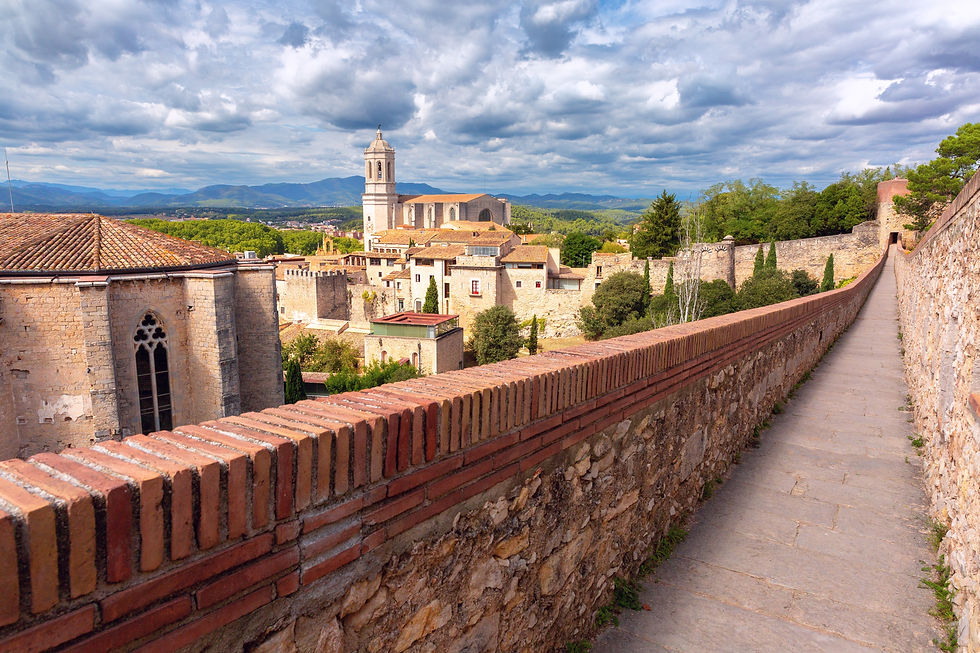
Location 4: Besalú — Procession of Sorrows
Address | Historic center, 17850 Besalú, Girona |
Distance from Girona | ~35 km northwest via the N-260 road |
Driving Time | ~30 minutes |
Elevation | ~170 meters above sea level |
Key Day | Friday before Palm Sunday (Procession of Sorrows / Procession of Dolors) |
Amenities | Medieval bridge, restaurants, Romanesque monastery, Jewish quarter museum |
Educational | 11th-century Romanesque bridge; medieval Jewish history museum (Mikve) |
Besalú is one of the best-preserved medieval towns in Catalonia. Its 11th-century fortified Romanesque bridge over the Fluvià river is the first thing that hits you when you pull into town. The cobblestone streets, arcaded squares, and intact medieval quarter make this place feel genuinely unaltered.
Holy Week here begins before Holy Week technically starts. The Procession of Sorrows (Processó dels Dolors) takes place on the Friday before Palm Sunday—a week earlier than elsewhere. The procession moves through the medieval streets and culminates at the Plaça Major, where the apostles sing the Salve while the Virgin is returned to the church in absolute silence. That silence is the thing people remember.
Besalú also holds a small but historically significant Jewish heritage museum (the Mikve, a medieval Jewish ritual bath), which adds a layer of historical complexity to what you're experiencing during Holy Week—a reminder of the multiple faiths that once coexisted, and often didn't, in medieval Catalonia.
Drive the N-260 northwest from Girona through flat farmland that gives way to gentle hills. The road is easy. The town rewards patience—walk it slowly.
The Break You Didn't Know You Needed
America has made Easter a pastel-colored long weekend. Chocolate eggs, maybe a church service if you're the type, and then back to the grind by Tuesday. The sacred has been almost entirely removed from the experience. You don't feel anything because there's nothing left to feel.
Spain—and specifically Girona—hasn't done that. Semana Santa Holy Week Girona is still publicly, unapologetically religious. It's not asking for your belief. It's simply happening, and it's been happening for centuries, and that weight is palpable.
When you stand in the dark on a medieval street in Verges at midnight, watching skeleton dancers move to the sound of a single drum, with nothing but torchlight around you, the phone goes in your pocket. Not because you decided to—because the moment doesn't allow distraction. That's the break. Not a beach. Not a bar. A moment that actually pulls you outside yourself.
After you leave—whether it's Girona's staircase at dusk or Verges at 2 am—something is different. You feel quieter. You've been part of something old and serious and communal. Most people describe it as feeling both small and calm at the same time. That's not a bad place to be.

5 Gold Nuggets
🏅 Gold Nugget #1: Verges is Non-Negotiable
If you're in the Girona area during Holy Thursday, you go to Verges. The Dance of Death has been running since 1666, it ends at 3 am, and it will be one of the most genuinely unusual things you ever witness. Book restaurant reservations early and plan to stay late.
🏅 Gold Nugget #2: Good Friday Belongs to Girona's Streets
The Manaies descending the cathedral steps on Good Friday evening is one of those images you carry for years. Position yourself near the base of the staircase before the procession begins. Arrive at least 90 minutes early for a good spot.
🏅 Gold Nugget #3: Altitude Changes the Experience
Sant Hilari Sacalm at 800 meters is a completely different emotional register from the coastal lowlands. The mountain air, the forest, the 300-year Via Crucis—this is the quieter, deeper version of the week. If you want perspective, drive up there.
🏅 Gold Nugget #4: Come as an Observer, Leave Changed
You don't have to be Catholic. You don't have to be religious at all. These are public events that welcome everyone. The value is in the presence, the atmosphere, and the genuine living tradition. Respect the communities hosting it and you'll be welcomed.
🏅 Gold Nugget #5: Plan the Week Like a Sequence
Friday before Palm Sunday: Besalú's Procession of Sorrows. Holy Thursday night: Verges. Good Friday: Girona city cathedral and Manaies procession. Good Friday alternate: Sant Hilari Sacalm Via Crucis. You can do all four in one week without doubling back.
References and Clickable Citations
SEO Primary Keyword: Semana Santa Holy Week Girona Spain
© 2026 — All facts verified. For corrections or updates, reference the official Catalan heritage listings above.


Comments